
What we took away from the III Congrés Catalunya Circular
There is no European model to copy, but there are ecosystems to learn from.
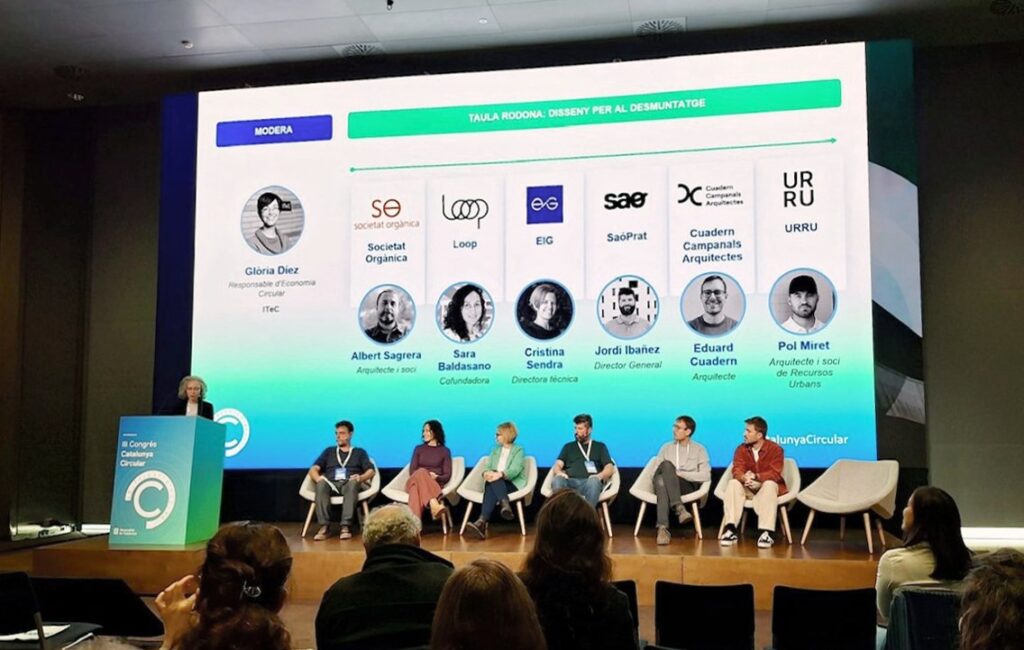
| Conference | III Congrés Catalunya Circular · 28–29 October 2026 · CCIB, Barcelona |
| Session | “Construcció 4.0: del tsunami normatiu al disseny per al desmuntatge”, organised by ITeC |
| Chair | Glòria Díez |
| Panel | Albert Sagrera Cuscó, Cristina Sendra, Jordi Ibáñez Ferrer, Eduard Cuadern, Pol Miret and Sara Baldasano |
Six professionals shared the panel at the ITeC session and, from different perspectives, we all talked about building with the resources that already exist: the building as a materials bank, dismantling to reuse and designing with future transformations in mind.
That reuse now has this place in the debate is a sign of progress. But there is still a lot of work to do before it becomes routine on site. Here we share some of the ideas that came up in the session and others that were left out.
Which models are working best to consolidate a market for reused products, and what lessons could we apply here?
I don’t think there is a winning model that can be exported. What works in Europe are ecosystems where three factors come together.
A complete, professional supply
It is not enough for the material to exist: infrastructure and actors are needed. Urban resource centres where material is recovered, stored and prepared, like the Leuven Materialenbank, opened by the city in 2021 and already recovering 250 tonnes a year[1][2].
And the material broker is needed, connecting supply and demand and delivering material with the technical conditions the architect needs in order to specify it.
Public demand
Public works must include conditions in their tenders that stimulate the market: reuse inventories, lots of reclaimed material.
It is the public sector that can take on the risk of the first operations and normalise the practice.
A regulatory framework that requires and rewards
Liability for reclaimed material is still unregulated: today we resolve it through agreements between actors, project by project. What is activating the market are the rules that require reuse, such as pre-demolition audits or limits on the carbon footprint of buildings. Denmark, for example, already limits the carbon of new buildings to an average of 7.1 kg CO₂ per square metre per year[3].
But on one condition: the calculation method must recognise reuse. If a reused material counts as a new one, the limit does not help[4]. The new EU Construction Products Regulation solves this: it covers used products, and their life cycle starts when they are dismantled[5]. France offers the opposite lesson: it has regulated a lot, but on waste rather than products, and has not met its reuse targets[6].
A concrete opportunity
The EU Energy Performance of Buildings Directive (EPBD) requires member states to present, in January 2027, their roadmap for limiting the carbon of new buildings[7]. Now is the time to make sure reuse counts.
And there is a gap: Spanish Law 7/2022 has required selective demolition since 2024, but it regulates waste separation, not product conservation[8]. What is missing is the pre-demolition audit as a prior step.
Not a new idea
In the year 458, Emperor Majorian held liable the officials who authorised dismantling public buildings to take away their stone[9], and the Theodosian Code already regulated how that dismantling should be done and what to do with the materials[10][11].
Before demolishing, someone had to decide what was kept. It is, in a way, the forerunner of the pre-demolition audit.
If you had to identify the main barrier between us and these success stories, would it be trust, logistics, cost, availability of materials or something else?
Trust, logistics or availability are symptoms of an underlying barrier: fragmentation.
Two separate processes
Today dismantling and building are two separate processes, with different actors, schedules and contracts. That is why material does not arrive when needed, information about it does not pass from one actor to the next, and no one is tasked with moving it from one site to another.
And when a difficulty arises, each actor takes the easiest solution for them, which is the linear one.
The De HER pact
I recently visited De HER in Rotterdam, a circularity centre built with material from a laboratory dismantled in Delft[12][13]. As they explained, they set a very high circularity target, around 90%, and agreed that whenever they faced a problem they could not solve, the solution could not be the linear one.
That shared commitment is what kept them from falling back on it.
Writing it into contracts
But it also shows a limit: it was a voluntary pact, on a municipal project, with material from a single source[12]. For this to scale, collaboration cannot depend on each team’s goodwill. It has to be written into contracts, with teams that bring together those who dismantle and those who build from the start[14][15].
There is a huge gap between aspiration and reality, and we only close it if collaboration stops being exceptional and becomes the normal way of working.
References
- VRT NWS, 20/12/2025. Leuven Materialenbank: opened in 2021; from 20 t (2022) to 250 t (2025).
- Atelier Circuler vzw, presentation (April 2025). Urban mining framework agreement with the city of Leuven; funding and certification challenges.
- The Civil Engineer, “Denmark phases in stricter CO₂ rules”. BR18: average limit of 7.1 kg CO₂e/m²/year from 1/7/2025.
- Nordic Council of Ministers (2023), Circular construction in the Nordic countries. The initial Danish calculation assigned reused materials the same emissions as new ones.
- Regulation (EU) 2024/3110 on construction products. Covers used products; the life cycle starts with uninstallation.
- REP PMCB (France): overhaul of the scheme, 2026. 2024 reuse target missed; AIMCC rejected the Government’s commitment (6/10/2026).
- Directive (EU) 2024/1275 (EPBD), art. 7, and European Commission, life-cycle GWP. Roadmap of limit values in January 2027; mandatory calculation in 2028 (over 1,000 m²) and 2030 (all new buildings).
- Spanish Law 7/2022 on waste and contaminated soils for a circular economy, art. 30. Selective demolition mandatory from 1/1/2024.
- Policy Options (IRPP), on Majorian’s Novel 4 (458). Penalties for officials who authorised dismantling public buildings.
- Arce, J. (2006), Archivo Español de Arqueología. Theodosian Code legislation on the conservation of temples.
- Religions (MDPI), 2024, 15(6):663. The Theodosian Code regulated the demolition of temples and the reuse of their materials.
- Circle Economy, “De HER, a circularity centre”. Single-source material, documented with a materials passport; N3O, BAM, DGMR.
- Rotterdam Style, “Rotterdam launches De HER”. Opened on 23/5/2025, Bovendijk 191.
- Bouwend Nederland, Materialen Expeditie 2022. Early collaboration and bouwteams as a condition for reuse to take off.
- City of Mechelen, Impuls circulair herbestemmen.